EB-2 NIW RFE 2026: Common Reasons, How to Respond & Timeline

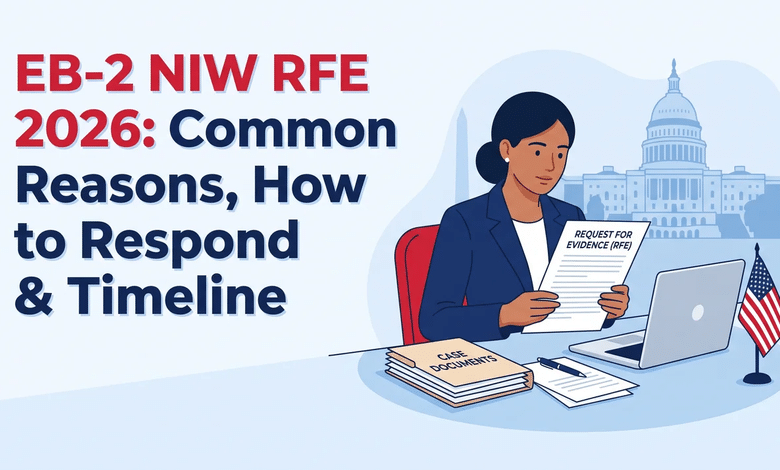
Receiving a Request for Evidence on an EB-2 National Interest Waiver petition does not mean USCIS has denied your case. It means the officer believes the record, as filed, does not yet establish one or more required elements and is giving you an opportunity to respond before a final decision.
For an EB-2 NIW case, an RFE may question the underlying EB-2 classification, one or more of the three Matter of Dhanasar prongs, the connection between your evidence and your proposed endeavor, or a procedural issue. A strong response therefore starts by identifying exactly what USCIS says is missing instead of simply sending more documents.
Quick answer: read the RFE line by line, calendar the exact deadline printed on the notice, map every USCIS concern to the legal standard and supporting evidence, respond to every issue in one organized submission, and keep proof of delivery. If your NIW case is in premium processing, the applicable premium-processing period begins again after USCIS receives the response under the premium-processing rules.
Last verified: August 21, 2026. This guide is educational information, not legal advice. RFE language is case-specific. If the notice raises a serious eligibility problem, inconsistent evidence, misrepresentation concern, or complicated immigration history, consider consulting a licensed U.S. immigration attorney.
What does an EB-2 NIW RFE mean?
An RFE is a formal USCIS request for additional evidence. Under 8 CFR 103.2, USCIS may request initial or additional evidence when the record does not establish eligibility. The notice identifies what evidence is being requested and gives a response deadline.
An RFE is different from a denial. USCIS has not yet issued a final adverse decision. But it is not harmless either: the officer has identified one or more weaknesses that must be addressed before the petition can be approved.
The useful question is not simply “Did I get an RFE?” but “What exactly does USCIS believe I have not proven?” Two NIW applicants can both receive RFEs for completely different reasons.
If you are still trying to understand the full case timeline, start with our EB-2 NIW processing time guide for 2026.
The legal framework behind an EB-2 NIW RFE
Before USCIS reaches the National Interest Waiver analysis, the petitioner must establish eligibility for the EB-2 immigrant classification. That generally means qualifying as a member of the professions holding an advanced degree or as a person of exceptional ability.
After the base EB-2 requirement is established, USCIS applies the three-part framework from Matter of Dhanasar:
- The proposed endeavor has substantial merit and national importance.
- The petitioner is well positioned to advance the proposed endeavor.
- On balance, it would benefit the United States to waive the job-offer and labor-certification requirements.
An RFE may challenge one element or several. Some notices accept the advanced-degree requirement but question national importance. Others accept national importance but conclude that the evidence does not show the petitioner is well positioned. Still others question the third prong or the underlying EB-2 classification.
Is there an official USCIS list of the most common NIW RFE reasons?
No current USCIS page publishes a simple ranked list of “the top EB-2 NIW RFE reasons.” Be cautious with websites that present precise RFE percentages without explaining the data source.
However, recurring issues are visible in the USCIS Policy Manual, the Dhanasar framework, and Administrative Appeals Office decisions. Those official materials repeatedly show the kinds of evidentiary gaps that can prevent an NIW petition from satisfying the legal standard.
The sections below therefore describe recurring NIW problem areas, not an official USCIS frequency ranking.
RFE issue #1: the proposed endeavor is too vague
One of the most important NIW distinctions is the difference between your occupation, your field, and your specific proposed endeavor. Saying that you are an engineer, physician, researcher, entrepreneur, software developer, or consultant does not by itself explain what you intend to do in the United States.
USCIS wants to understand what you actually plan to do, how you intend to do it, who or what will be affected, and why the prospective impact matters. AAO decisions repeatedly emphasize that national importance is assessed by looking at the specific endeavor, not simply at the general importance of the industry.
Evidence that may help clarify the endeavor
- A precise proposed-endeavor statement;
- A credible implementation plan with specific activities and milestones;
- Evidence showing the prospective reach or broader implications of the work;
- Independent documentation connecting the specific endeavor to a U.S. need, priority, technology, policy objective, economic effect, public-health goal, or other relevant interest;
- Evidence explaining why the project is more than ordinary work in an important occupation.

RFE issue #2: USCIS questions national importance
“Substantial merit” and “national importance” are separate concepts. A project can have substantial merit in business, science, technology, health, education, culture, or another field and still fail to demonstrate national importance.
A frequent weakness is relying too heavily on reports showing that the industry is important. Evidence that artificial intelligence, cybersecurity, renewable energy, healthcare, aviation, or semiconductors are strategically important does not automatically prove that one petitioner’s proposed endeavor has broader national implications.
USCIS guidance focuses on the prospective impact of the specific endeavor. Depending on the case, relevant evidence can involve national or global implications within a field, significant economic effects, job creation, important research or technology, public welfare, or other broader consequences.
A useful national-importance test
Ask yourself: If USCIS removed my résumé and job title and looked only at the proposed endeavor, would the evidence still explain why the endeavor matters beyond my own employer, clients, career, or local business? If not, the response may need a clearer bridge between the proposed work and its prospective impact.
RFE issue #3: USCIS questions whether you are well positioned
The second Dhanasar prong asks whether you are well positioned to advance the endeavor. This does not require certainty that the project will succeed, but USCIS looks for evidence showing that you have a credible basis to carry it forward.
Potential evidence varies by field and can include education, specialized knowledge, a record of success, publications, citations, patents, funding, contracts, business traction, licenses, awards, media coverage, invitations, prior project results, government interest, customer demand, collaboration agreements, or other objective indicators.
The strongest evidence does more than prove that you are talented. It explains how your past record and present resources connect to the specific proposed endeavor. Ten publications are not automatically persuasive if they concern a different topic. A successful business is not automatically persuasive if the record does not show how it supports the future U.S. plan.
RFE issue #4: recommendation letters are too general
Recommendation and expert letters can be useful, but they are not magic documents. A letter that merely repeats your résumé, calls you “exceptional,” or says your field is important may add little if it does not explain concrete facts.
A stronger letter can identify the writer’s basis of knowledge, describe specific contributions, explain why those contributions matter, discuss the proposed endeavor in detail, and connect your record to your ability to advance that endeavor.
Independent letters can sometimes be useful because they show recognition beyond your immediate employer or collaborators, but independence alone does not turn a weak letter into strong evidence.
RFE issue #5: the evidence proves the field matters, but not your project
Applicants often submit government reports, labor-shortage articles, White House strategy documents, industry forecasts, and news coverage demonstrating that a broad sector matters to the United States. Those sources can provide context, but they should not be the entire national-importance argument.
USCIS still needs the bridge from national policy to your proposed endeavor. A federal report identifying AI as strategically important may support the context of an AI endeavor. It does not by itself establish that ordinary software work at one company has national importance.
RFE issue #6: the third Dhanasar prong is not developed
The third prong asks whether, on balance, it would benefit the United States to waive the normal requirements of a job offer and labor certification. This is not the same as proving you are employable or that employers want your skills.
The response should explain why the ordinary labor-certification framework would be impractical or contrary to the national benefit in the circumstances of the proposed endeavor. A researcher may need flexibility to work across institutions. An entrepreneur may advance a venture that does not fit a conventional employer-sponsored structure. A specialist may pursue projects or collaborations whose national benefit is not captured by one permanent job offer.
RFE issue #7: USCIS questions the underlying EB-2 qualification
NIW is a waiver layered on top of EB-2 classification. You must first qualify for EB-2 through the advanced-degree route or exceptional-ability route. An RFE can therefore ask for additional proof of a degree, progressive post-baccalaureate experience, foreign-credential equivalency, or exceptional-ability criteria before USCIS reaches the NIW prongs.
If the RFE raises this issue, do not respond only with more national-interest evidence. The base classification is an independent requirement and should be addressed separately and completely.
How long do you have to respond to an EB-2 NIW RFE?
Use the deadline printed on your RFE notice. Do not calculate your response date from a blog, forum post, or someone else’s case.
USCIS rules provide that an RFE must state the response deadline and that the maximum response period cannot exceed 12 weeks. USCIS guidance also explains that additional time beyond the permitted response period is not granted. The actual notice may provide less than the maximum.
Calendar the due date immediately and work backward to allow time for expert letters, records, translations, business evidence, or other documents. Follow the filing instructions on the notice exactly.
Should you send a partial response and add evidence later?
Do not assume USCIS will give you a later opportunity to supplement the record. Plan to submit one complete response addressing every issue by the deadline. Treat the RFE as a controlled project: identify each issue, collect evidence, build the explanation, assemble exhibits, verify the deadline, and submit the full package.
A practical EB-2 NIW RFE response framework
| Step | Question to answer | Output |
|---|---|---|
| 1. Parse the RFE | What exact legal or evidentiary issue did USCIS identify? | Issue list using the officer’s headings |
| 2. Map the standard | Which EB-2 requirement or Dhanasar prong does each issue involve? | Legal-standard map |
| 3. Audit the original filing | What was already submitted, and why did it fail to persuade? | Gap analysis |
| 4. Choose new evidence | What document directly closes each gap? | Evidence plan |
| 5. Build the explanation | How does each exhibit prove the required element? | Response argument |
| 6. Cross-reference exhibits | Can the officer locate every document quickly? | Indexed exhibit package |
| 7. Quality check | Did you answer every issue and avoid contradictions? | Final response package |
| 8. File and preserve proof | Was the response delivered correctly and on time? | Tracking and complete copy |
The RFE evidence matrix: a simple way to avoid missing an issue
For a complex notice, create a private working table before drafting. This is especially useful when USCIS questions multiple prongs.
| USCIS concern | Original filing | Gap | New evidence | Response section |
|---|---|---|---|---|
| National importance | General industry reports | Connection to specific endeavor | Project evidence + independent impact documentation | Section I |
| Well positioned | Résumé + degree | Objective proof relevant to endeavor | Results, citations, contracts, awards, funding or other records | Section II |
| Third prong | Generic paragraph | Case-specific balancing analysis | Evidence explaining why waiver advances the endeavor and U.S. benefit | Section III |
This matrix is not a USCIS form. It is an internal organization tool that forces you to match every new exhibit to a specific problem instead of adding volume for its own sake.
More evidence is not always better evidence
An RFE response can become weaker when it buries the officer under hundreds of pages that do not answer the concern. The objective is not to make the package physically larger. It is to make eligibility easier to understand and verify.
- Which exact RFE issue does this document address?
- What fact does it prove?
- Why is that fact relevant to the legal standard?
- Is the source credible and, where useful, independent?
- Does it contradict anything already in the record?
- Can the officer understand its significance without guessing?
What happens after USCIS receives the RFE response?

USCIS resumes adjudication after the response is received. The next action can be an approval, denial, another notice where appropriate, or another case-status update.
There is no universal standard-processing promise that every non-premium NIW RFE response will receive a decision within a fixed number of days. Timelines vary by workload, case complexity, and service-center operations. Use the official USCIS case-status and processing-time tools instead of relying on one applicant’s timeline.
What happens to premium processing after an NIW RFE?
EB-2 NIW Form I-140 petitions are eligible for premium processing. For NIW, USCIS uses a 45-business-day premium-processing period for qualifying adjudicative action.
If USCIS issues an RFE or certain other notices, a new applicable premium-processing period begins after USCIS receives the response. An RFE can therefore materially extend total elapsed time even though the petition remains in premium processing.
Premium processing guarantees a service period for USCIS action; it does not guarantee approval. For current fees, timing and upgrade rules, see our EB-2 NIW premium processing guide.
Does an RFE mean your EB-2 NIW will be denied?
No. An RFE is not a denial. But it is equally misleading to call it harmless. The officer has identified a deficiency, and the response may be your most important opportunity to repair the record before a final decision.
Do not rely on unofficial “approval-after-RFE rates” unless the source clearly describes its dataset. USCIS does not publish a simple current nationwide statistic that tells one individual applicant the probability of approval after an NIW RFE.
Can premium processing cause an RFE?
Premium processing does not change the NIW legal standard. USCIS applies the same eligibility requirements under regular and premium processing. Faster adjudication can simply produce a faster request for missing evidence if the original petition did not clearly establish eligibility.
Should you hire a lawyer for an EB-2 NIW RFE?
An attorney is not legally required for every NIW RFE. Some self-petitioners prepare their own filings and responses. But an RFE is a reasonable point to consider professional review because the notice tells you exactly where USCIS sees a problem.
Professional help may be especially valuable when the RFE challenges all three Dhanasar prongs, questions the base EB-2 classification, identifies contradictions, raises credibility concerns, or involves a complicated procedural history.
EB-2 NIW RFE response checklist
- Read the entire RFE, including every page and attachment.
- Record the exact response deadline.
- Identify whether USCIS questions EB-2 eligibility, Dhanasar prong 1, 2, 3, or multiple issues.
- Compare each concern with what you already submitted.
- Do not merely resend the same evidence without explaining why it proves the requirement.
- Use new evidence that directly addresses identified gaps.
- Connect every major exhibit to a legal or factual point.
- Check dates, job titles, project descriptions, publications, business claims and other facts for consistency.
- Include certified translations when required.
- Organize the response with headings and an exhibit index.
- Follow the filing location and submission instructions on the RFE exactly.
- Keep a complete copy and proof of delivery.
How an RFE affects your total EB-2 NIW timeline
An RFE affects the I-140 adjudication stage, but the I-140 is only one clock in the overall green-card process. After approval, you may still need to wait for visa availability under the Department of State Visa Bulletin and then complete adjustment of status through Form I-485 or immigrant-visa processing abroad.
Responding quickly to an RFE does not make a backlogged priority date current. Likewise, premium processing can accelerate I-140 adjudication but cannot accelerate the Visa Bulletin itself. Our guide to faster U.S. green-card pathways explains why petition speed, visa availability, and final processing are separate factors.
Five mistakes that can make an NIW RFE response weaker
- Answering what you wish USCIS had asked. Organize the response around the actual notice, not a generic template.
- Proving that your industry matters instead of proving that your endeavor matters.
- Submitting impressive evidence without connecting it to the legal standard.
- Creating contradictions while trying to strengthen the case. New project descriptions, dates, job duties or business plans should remain consistent with the record or clearly explain legitimate changes.
- Waiting until the deadline to begin. Independent letters, translations and project evidence can take time to obtain.
A better way to think about an NIW RFE
Treat the RFE as an adjudicator’s map of the weaknesses in the current record. The notice tells you where the officer is unconvinced. Your job is to make the next review easier, not louder.
- Specific: answer the actual RFE wording.
- Structured: give each issue its own section and exhibits.
- Evidence-driven: support factual claims with credible records.
- Connected: tie evidence to EB-2 and Dhanasar requirements.
- Consistent: avoid silent contradictions with the original filing.
- Timely: make sure USCIS receives the response according to the notice.
A concise response that closes every evidentiary gap can be stronger than a massive package filled with repetitive documents. For more articles in this cluster, visit our Employment-Based Immigration section.
Official sources
- USCIS Policy Manual — Advanced Degree or Exceptional Ability and National Interest Waiver
- USCIS — Form I-140
- USCIS — Form I-907 Premium Processing
- USCIS — Case Processing Times
- USCIS — Filing Periods and RFE Response Timeframes
- USCIS — Adjudication Process and RFE Guidance Cross-Reference
- USCIS AAO — Non-Precedent Decisions
- eCFR — 8 CFR 103.2
FAQ: EB-2 NIW RFE in 2026
Does an EB-2 NIW RFE mean my case will be denied?
No. A Request for Evidence is not a denial. USCIS is giving you an opportunity to provide additional evidence or explanation before completing adjudication. The RFE does identify a deficiency that should be addressed carefully.
How long do I have to respond to an EB-2 NIW RFE?
Use the exact deadline printed on your USCIS notice. Regulations provide that the maximum RFE response period cannot exceed 12 weeks, but an individual notice can provide a shorter period.
What are common issues in EB-2 NIW RFEs?
USCIS does not publish a simple ranked list. Recurring issues visible in policy guidance and AAO decisions include an unclear proposed endeavor, insufficient national importance, questions about whether the petitioner is well positioned, weak evidence-to-endeavor connections, third-prong issues, and underlying EB-2 eligibility.
Can I submit more evidence after my RFE response?
Do not assume USCIS will permit a later supplement. Plan to submit one complete response addressing every issue by the deadline and follow the notice instructions exactly.
What happens to premium processing after an NIW RFE?
For an eligible EB-2 NIW I-140 in premium processing, USCIS uses a 45-business-day service period. A new applicable service period begins after USCIS receives the response under the premium-processing rules.
Does premium processing increase the chance of an RFE?
Premium processing does not change the NIW legal standard. It accelerates USCIS action, so a deficient petition may receive an RFE sooner, but the substantive requirements remain the same.
Should I send more recommendation letters after an RFE?
Only if the letters directly address an identified issue and provide useful, credible facts. More letters are not automatically better.
Can USCIS question all three Dhanasar prongs in one RFE?
Yes. An RFE can challenge one prong, multiple prongs, or the underlying EB-2 classification. The response should separately address every issue USCIS identifies.
How long after an RFE response will USCIS decide an NIW case?
There is no single guaranteed timeline for standard processing. Premium-processing NIW petitions are subject to the applicable 45-business-day service period after USCIS receives the response.
Do I need an attorney to respond to an EB-2 NIW RFE?
An attorney is not legally required for every NIW RFE, but professional review may be valuable when the notice challenges multiple prongs, questions EB-2 classification, identifies contradictions, or raises complex issues.